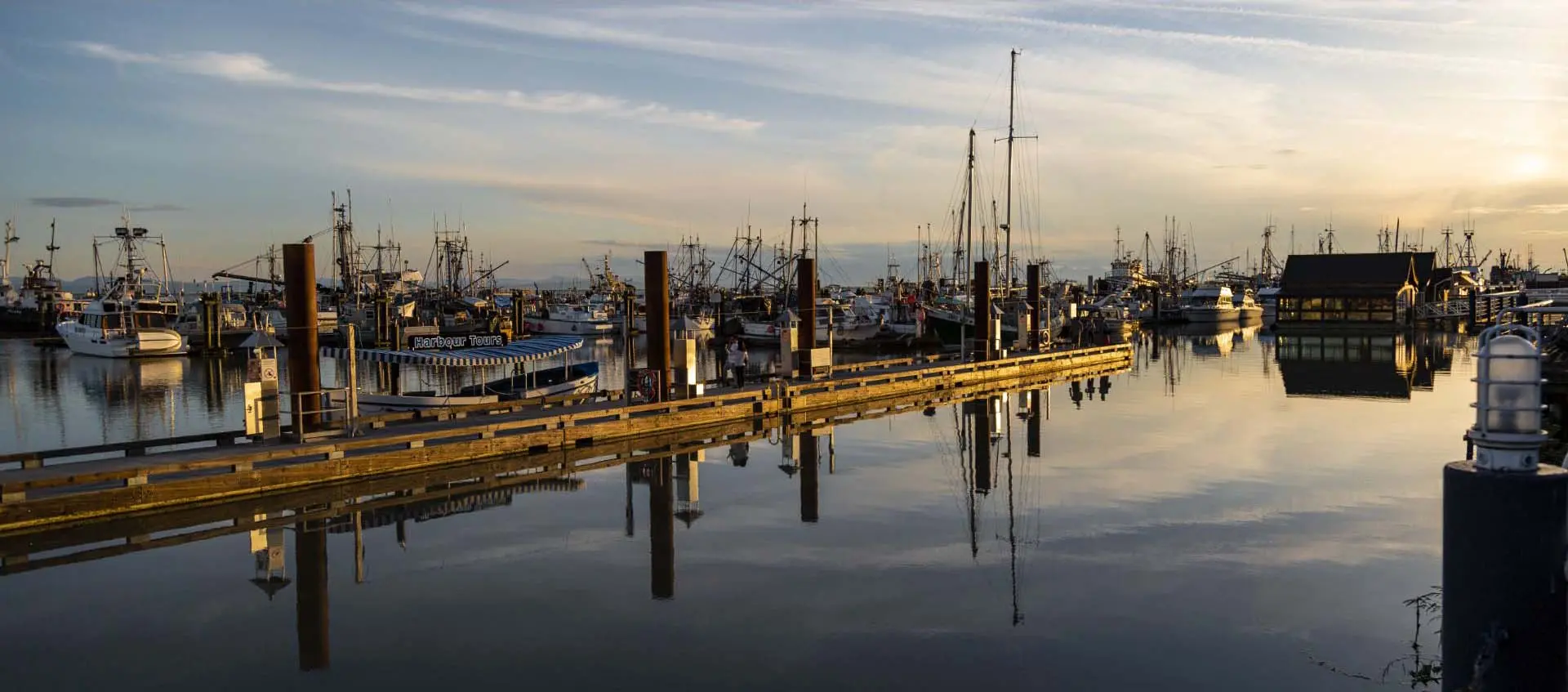
What we see in Sea Island
Sea Island is geographically distinct from the rest of Richmond. YVR Vancouver International Airport occupies most of the island. The residential neighbourhood of Burkeville sits in the southwestern corner (covered in its own page). The rest of Sea Island is a mix of:
Airport operations. Hangars, charter operations, maintenance facilities, ground-handling buildings.
Light commercial and industrial. Air-cargo operations, airport-services support buildings, charter and corporate flight facilities.
Marine-services and aviation-services businesses. Charter operators, fixed-base operations.
Burkeville residential. (See the Burkeville page for residential details.)
Garage door reality: - Heavy commercial-grade work — large industrial doors, hangar doors, cargo bay doors - Highly corrosive environment — direct salt-air exposure from surrounding water plus airport-related particulate from jet exhaust and aircraft operations - Cycle counts vary wildly — some commercial doors cycle 500+ times per day, others cycle once a week - Wind exposure is significant — the airport runways generate wind tunnel effects across the apron
Sea Island is the most corrosive environment in Richmond for garage doors. IPPC-90 corrosion coatings are mandatory. Stainless cables are standard. Galvanized hardware throughout.
What fails first on Sea Island
Spring corrosion at accelerated rate. Sea Island salt-air aggression combined with airport particulate cuts standard spring life roughly in half compared to inland Richmond. Even IPPC-90 corrosion-coated springs need replacement at 5–8 years on heavy-cycle commercial.
Cable corrosion. Standard galvanized 7x19 cables fail in 4–7 years on Sea Island. Stainless steel cables are the better economics here despite the higher upfront cost.
Sectional panel corrosion. Steel panels develop pitting and edge corrosion faster than anywhere else in Richmond.
Hardware corrosion on hinges, brackets, and track mountings if not galvanized.
Photo-eye electronic failures. Salt-driven contact corrosion is aggressive.
Wind-load damage. High-wind events from runway operations and storms.
What we recommend on Sea Island
- IPPC-90 corrosion-coated 50K or 100K-cycle springs mandatory.
- Stainless steel 7x19 cables standard.
- Galvanized hardware throughout.
- Wind-load reinforced sectional doors for any exposed location.
- Aluminum frames where corrosion is most aggressive (full-view doors with aluminum framing don't rust the way steel frames do).
- Annual or semi-annual maintenance. Mandatory for commercial operations.
- Stainless or marine-grade hinge and bracket hardware as upgrade options.
What we install on Sea Island
Heavy mix of commercial-grade work:
- Commercial spring pair (50K-cycle, IPPC-90): $865–$1,685.
- Commercial spring pair (100K-cycle, IPPC-90): $1,485–$2,685.
- Stainless commercial cable pair: $485–$885.
- LiftMaster MJ5011U installed: $1,485–$2,485.
- LiftMaster MH5011U installed: $1,295–$2,285.
- LiftMaster GH5011L heavy-duty: $2,485–$4,285.
- Commercial sectional 12x12, IPPC-coated, wind-load reinforced, installed: $7,200–$10,500.
- Commercial sectional 16x14, wind-load reinforced, installed: $9,800–$14,800.
- Commercial sectional 24x14, wind-load reinforced (small hangar): $14,500–$22,500.
- Commercial roll-up 12x12, marine-grade slats: $9,800–$14,500.
- Annual commercial maintenance contract: $2,485–$4,485/year depending on door count and complexity.
Response time from the shop
From Moncton Street in Steveston to Sea Island is 25–35 minutes — depending on which side of the island and which bridge route works at the time. Arthur Laing Bridge access via Russ Baker Way is the most common route. Same-day emergency response possible but typically 45–90 minutes due to distance and airport-area traffic.
A specific Sea Island story
A small charter-floatplane operator on Sea Island called me last fall (2025). Their hangar had a 24x14 sectional door from the late 1990s. The door panels were corroded from constant salt-air exposure — Sea Island is surrounded by water and the runway winds carry salt aerosol all over the apron buildings. The springs were on their fifth replacement since the door was installed. The operator wanted to know: replace the door, or convert to roll-up?
I quoted both: - New sectional, insulated R-12, wind-load reinforced, with new commercial operator: $18,250 - New roll-up, insulated as best as roll-up can do (R-9), with heavier commercial operator and brake: $24,750
But the math wasn't just upfront cost. The roll-up would last longer in cycle terms but the salt air would eat the slat curtain edges as fast as it ate the sectional panels. And the sectional was easier for them to service in their corrosive environment because individual panels can be swapped without taking down the whole curtain.
I recommended the sectional. They went with the recommendation. Three months later the new door is working, the manager texted me a photo of a Beaver taking off framed by the new door opening. They saved $6,500 and got the door that fit their actual operational pattern.
Sometimes the wrong question is "roll-up or sectional." The right question is "what fails first in your specific environment, and how easy is the repair when it does."
Another Sea Island call: a small air-cargo operation needed two 12x12 commercial sectional doors replaced because the original 2003 doors had developed panel-corrosion holes large enough to let rain into the building. They'd been patching with sheet metal for two years. Replaced both doors with IPPC-coated, wind-load reinforced, R-12 insulated commercial sectionals. Total: $16,800 for the pair installed, with new LiftMaster MJ5011U operators and stainless cables.
The previous installer hadn't spec'd corrosion-resistant components. The result: 22-year doors that should have lasted 25–30 years failed early. The math on getting the spec right on Sea Island is overwhelming.
Related blog posts
- Roll-Up Doors vs Sectional Doors for Richmond Commercial →
/blog/post-15-rollup-vs-sectional/ - The Insulation Question: R-Value vs Reality in Richmond →
/blog/post-8-insulation-r-value/ - What a Torsion Spring Actually Costs (And Why) →
/blog/post-4-torsion-spring-real-cost/
Call us
Sea Island commercial and industrial service. Marine-grade corrosion specifications. Annual maintenance contracts strongly recommended for any commercial Sea Island door.