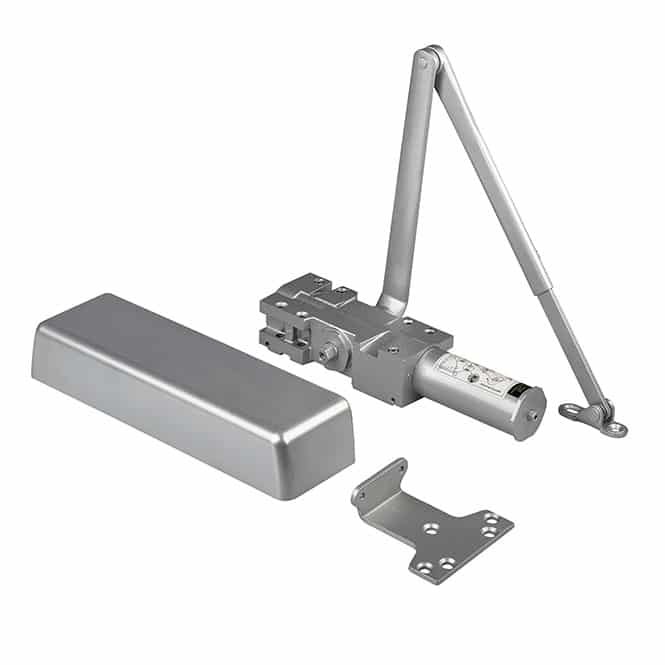
The North American workhorse. The single most common closer on Richmond commercial mandoors.
- Cast iron body
- Adjustable spring sizes 1β6
- ANSI A156.4 Grade 1
- Hold-open arm option
- Backcheck + delayed action
- 10-yr warranty
The smart structure for any Richmond building with multiple mandoors: a single visit covers every door on the property, with per-door rates that drop sharply with volume.
Bundled with overhead door / dock equipment / sliding gate maintenance under a single facility contract. Volume rates apply at 4+ doors on a coordinated visit. 2-year labour warranty on every job.
The industry calls it a "mandoor," "man door," "personnel door," "pedestrian door," "service door," or just "the back door." It's the steel door beside or behind the overhead door β the one people walk through when the overhead is closed. Almost always 1-3/4" thick, almost always 16- or 18-gauge cold-rolled steel skins over an insulated core, almost always set in a welded or knock-down hollow metal frame.
In a Richmond warehouse, mandoors typically serve: - Personnel entry next to a sectional overhead loading door - Employee entry/exit at the side or back of the building - Service access to mechanical rooms, electrical rooms, sprinkler rooms - Fire exits with panic hardware - Roof access doors - Stairwell doors connecting parkade levels to upper floors
In a Richmond strata building, mandoors typically serve: - Garbage and recycling rooms - Electrical and mechanical rooms - Storage locker access doors - Bike room access - Fire stairwell doors
Every one of them is doing safety-critical work. None of them get any attention until they fail.
The cylindrical or arm-mounted closer above the door fails β leaks hydraulic fluid, loses tension, lets the door slam or hang open. A fire-rated door that doesn't self-close fails its rating instantly. Closer replacement is a 30-minute job and the most common mandoor service call we run.
Common brands we service: LCN, Norton, Sargent, Yale, Dorma, Allegion, Pemko.
Heavy commercial doors hung on 4.5" x 4.5" steel hinges eventually loosen the hinge screws in the frame. The door starts to drag on the threshold, the closer can't close it, and the latch misses the strike. We re-hinge, weld in new screw anchors where needed, or convert to continuous hinge for high-cycle openings.
The push bar that opens the door from the inside β required on fire exits and high-occupancy egress doors. Failure modes: latch retraction stuck open (door won't lock), latch retraction stuck closed (door won't open from the inside β a serious code violation), or worn cam mechanisms. Common brands: Von Duprin, Sargent, Yale, Detex, Falcon.
The perimeter weatherstrip around the door tears, hardens, or peels off. Air infiltration kills HVAC efficiency, water gets in, dust gets in, the bottom door sweep wears through, the floor stains, and in food-grade applications the building loses its inspection rating. Replace seals every 5β7 years on exposed exterior mandoors.
Forklift strikes, deliberate prying, settling buildings. The frame bends or splits at the strike plate, the head, or the hinge jamb. We either weld and reinforce in place or replace the frame entirely depending on damage extent.
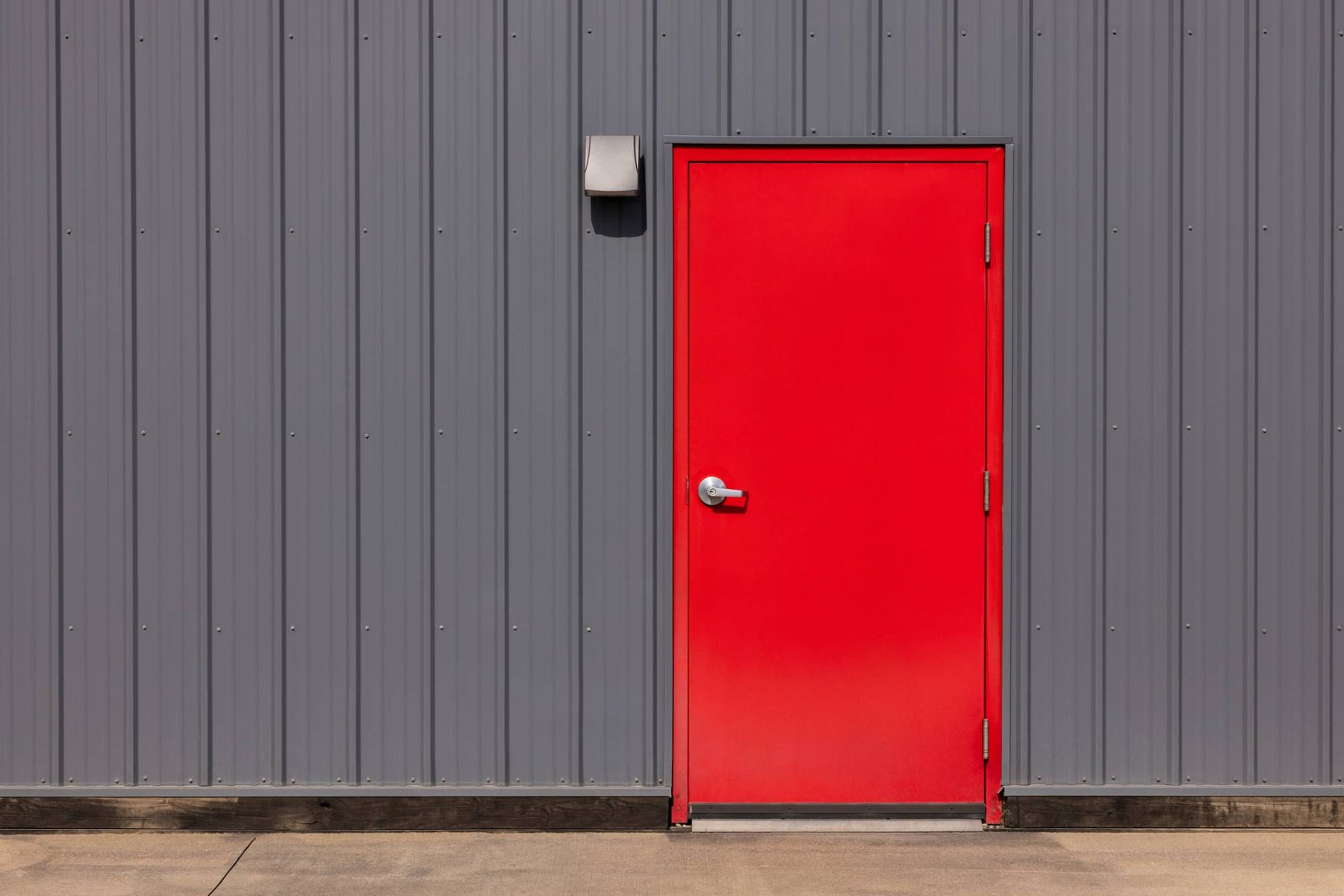
Fire-rated doors are tested and labeled to withstand fire exposure for a specified period before failing. The label rating must match the rating of the wall the door sits in:
180-minute (3-hour) β fire walls, between differing occupancy types, the highest-rated openings in a building
Carry a permanent metal label from a recognized testing lab (UL, Warnock Hersey/Intertek, ITS) β not a sticker, a riveted plate
WorkSafeBC inspectors and the fire marshal will write up every one of these. We bring them into compliance.
ANSI A250.4 cycle testing (1,000,000 cycles for high-use doors)
16-gauge welded knock-down hollow metal frames, ANSI A250.8 compliant
Continuous welded frames for fire-rated and security applications
161 cylindrical lock prep
Closer reinforcement standard
Schlage, Sargent, Yale, Corbin Russwin (mortise locksets)
Most Richmond commercial buildings have at least one overhead door and at least two mandoors. When those are split across two vendors, here's what actually happens:
When we run one truck for both: - One scheduled visit covers overhead + mandoors + perimeter gate (if any) + dock equipment (if any) - Lubrication, closer adjustment, weather seal inspection β same techs, same trip - A single 21-point inspection sheet runs across the whole building's mechanical access systems - One invoice, one warranty contact, one phone number
For a Richmond warehouse with a 30-bay operation that includes overhead doors, mandoors, dock equipment, and a perimeter gate, this consolidation typically saves 25β35% in annual service spend versus running 3β4 specialty vendors.
For new mandoor and frame installations, we partner with a regional steel door fabricator for door and frame supply. The doors we install are spec-grade, ANSI A250.8 compliant, available in fire ratings from 20 minutes to 3 hours, with full hardware kits pre-installed where possible.
Specialty hardware (electrified locks, magnetic strikes, access-controlled exits): coordinated with your security integrator
Standard 36" Γ 80" non-rated mandoor with knock-down frame, basic lever lock, closer, weather seal β installed: from $1,489
All pricing is for Richmond locations. Custom sizes, specialty hardware, and high-security spec quoted on-site with a written firm price before any work begins.
Steveston warehouse and strata maintenance contracts can include every mandoor on the property. Per-door rate is roughly half the overhead door rate because the inspection scope is smaller.
21-point mandoor inspection per visit: - Door slab condition (panels, dents, rust-through, paint integrity) - Hinge condition and screw torque - Frame condition (out-of-plumb, damage, rust) - Lock and latch operation (key, lever, panic device) - Closer operation (full close, latch under pressure, hydraulic fluid level) - Weather seal and door sweep condition - Fire label legibility (rated doors) - Self-closing and self-latching test (rated doors) - Threshold condition - Strike plate alignment - Vision panel integrity (where present) - Astragal seal on door pairs
Per-door rate on a maintenance program: - Annual plan: from $79/door/year - Bi-annual: from $69/door/visit - Quarterly: from $59/door/visit
Bundled with overhead door and dock equipment maintenance under a single facility contract.
A failed closer on a fire-rated mandoor is an instant code violation β the door is no longer self-closing. Closer replacement is a 30-minute job. We stock the most common units on every truck.

The North American workhorse. The single most common closer on Richmond commercial mandoors.

Premium grade-1 closer. Common in Richmond institutional and high-cycle commercial.

German-engineered. Common on Richmond European-influenced commercial buildings and high-end strata.

Robust commercial closer. Common on Richmond warehouse personnel entries β built to take abuse.

The right way to legally prop a fire-rated door open β auto-releases on alarm. Replaces the wedge.

Specialty closer for high-cycle warehouse use. Pneumatic operation, longer life under heavy use.
A panic bar that won't retract from the inside is a code violation that gets buildings shut down on inspection. We service every major brand and stock the most common rim devices on the truck.

The standard panic bar across North American commercial buildings β and the most common one we replace in Richmond.

Grade-1 panic device with electrified options. Common in Richmond high-security and access-controlled commercial.

Concealed vertical rod variant β used where aesthetics matter on Richmond commercial entries.

Industrial-grade alarm and night-latch exit devices. Common at Richmond warehouse delayed-egress and back-of-house.
We supply and re-key every major brand. For high-security applications (restricted keyways, master-key schedules) we partner with a Richmond commercial locksmith for cylinder work.

The premium mortise lockset for Richmond commercial β used where the building owner wants 50-year hardware.

Grade-1 cylindrical lock for commercial mandoors that don't need mortise. Standard Richmond commercial spec.

Commercial mortise alternative to Schlage L9000. Common on Richmond institutional and government buildings.

Electric-strike or electrified-trim mortise for access-controlled Richmond commercial doors.
Hinge sag and stripped frame screws are the second-most-common mandoor failure. We re-hinge, install screw anchors, or convert to continuous hinge for high-cycle openings.

The North American standard for commercial mandoor hinges. 4.5" Γ 4.5" heavy ball-bearing.

Continuous hinges for high-cycle Richmond warehouse personnel entries. Eliminates hinge sag at the source.

Self-closing spring hinges for residential-grade fire doors and some Richmond strata applications.

Stainless steel hinges for Richmond food-grade, wash-down, and coastal-exposed installations.
All doors supplied with matching welded or knock-down hollow metal frames. Fire-rated doors include label inspection and field-compliant installation.

Standard 1-3/4" hollow metal doors. The bread-and-butter Richmond commercial mandoor.

20, 60, and 90-minute fire-rated mandoors with UL or Warnock Hersey label. Required between specific Richmond building zones.

Heavy 18-gauge industrial mandoors for Richmond warehouse personnel entries. ANSI A250.4 1M-cycle tested.

Pre-finished architectural hollow metal for Richmond commercial entries that face the public.
"Mandoor" is the industry term for a commercial-grade steel pedestrian door β typically a 1-3/4" thick hollow metal door in a steel frame, used in industrial, warehouse, strata, and institutional buildings. A "regular pedestrian door" might be wood, fibreglass, or aluminum-framed glass β those are residential or office applications. Mandoors are built for high cycle counts, weather exposure, fire rating, and security.
No β and it's one of the most common code violations we see in Richmond. A fire-rated door's rating is based on its ability to self-close and self-latch when a fire alarm activates. A door that's wedged, chained, or held open by anything other than a fire-marshal-approved hold-open device (which automatically releases on alarm) loses its rating the moment it's propped open. WorkSafeBC, the BC Fire Code, and most facility insurers all write up propped-open fire doors as immediate violations.
7β12 years on standard cycle use. Heavy-cycle entry doors at warehouse personnel entries sometimes burn through closers in 4β5 years. We track closer condition on every maintenance visit and recommend replacement before failure.
Yes. We can re-key existing locks to a master keying schedule, replace cylinders, or coordinate with your locksmith on a building-wide rekey. For high-security applications (restricted keyways, electronic locks, access-controlled doors), we partner with a Richmond commercial locksmith.
Hollow metal doors are heavier, stronger, fire-ratable, and used at back-of-house, service, and emergency egress points. Aluminum doors (typically used at building main entrances with glass) are lighter, less expensive, and used in office and retail front entries. We don't service aluminum entrance doors β that's a different specialty.
Yes. Our fabrication partner can produce custom-size hollow metal doors and frames. Lead time is typically 3β4 weeks for non-standard sizes. We measure on-site and submit shop drawings for your approval before fabrication.
Look for a permanent metal label on the hinge edge of the door (and a matching label on the frame). The label will show the fire rating in minutes (20, 45, 60, 90, or 180), the testing laboratory (UL, Warnock Hersey/Intertek, or ITS), and a unique listing number. If the label is missing, painted over, or unreadable, the door has effectively no rating β even if it was originally fire-rated. We can survey your building and document every door's current rating status.
Yes for the door hardware itself. For the access control integration (card readers, FOBs, building access systems), we coordinate with your security integrator. We carry common electric strikes (HES, Folger Adam, Von Duprin) and magnetic locks (Securitron, Locknetics) on the truck.
From order to install, typically 10β15 business days for standard sizes with 60- or 90-minute rating. Same-day install once the door arrives, including frame replacement if needed.
Yes β and most Richmond strata corporations should. Garbage room doors, mechanical room doors, electrical room doors, and stairwell doors are all strata responsibility (common property). Adding them to the same contract as parkade gates and roll-up doors typically saves 25β30% versus separate vendors.
Send us your building address and a rough door count (overhead doors, mandoors, gates, dock equipment). We'll quote everything under a single facility contract β or by-the-call for one-off repairs.